
We Were Fed Too
A Sermon for November 26

The following is the text of the Homily I preached at St. Peter’s Episcopal Church on November 26, 2023. You can find the passages that I am referencing here.
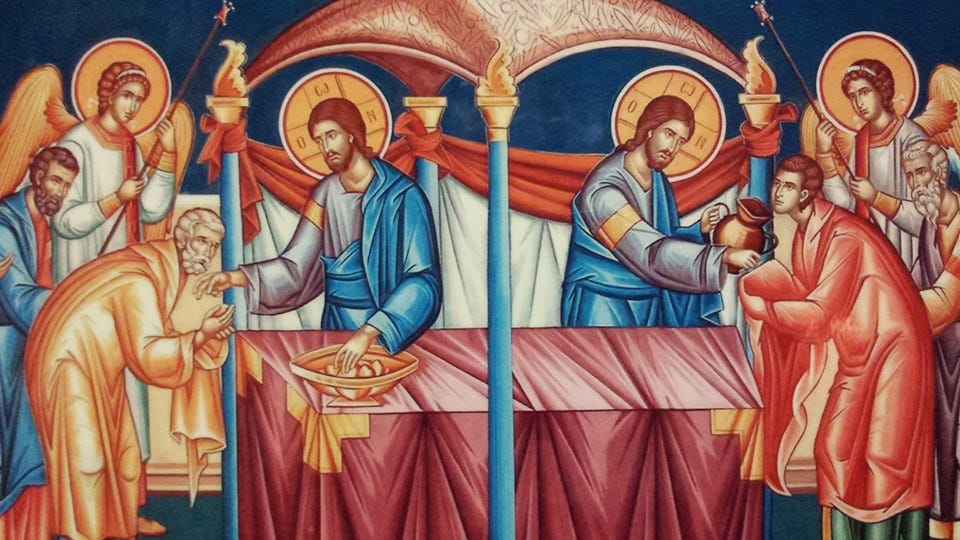
I hope everyone had a nice Thanksgiving. I’ve always loved that this is a holiday centered around a meal. It’s a very human thing to take something we have to do, eating, and add to it joy and traditions and ritual. Because Thanksgiving is not just about the food. It’s about time with friends or family. It’s about that liminal space of doing nothing between preparation tasks. It’s about being present with one another.
I realize a meal like this can be complicated. It can bring an equal share of pain and joy, when one of these things is lacking or out of balance. That too is part of the human experience. But whichever human experience you have been having this last week, I’m glad that you’re here.
This morning I’d like to share a story about another meal that impacted me profoundly. Several years ago, before Covid, the youth group went to Asheville, North Carolina for a summer mission trip. We were going to be serving for a week with an organization called Youth Mission Co. They work with and develop longstanding relationships with local nonprofits and charities and then invite groups from all over the country to come, to serve, and to learn alongside folks from the community.
Over the course of the week we heard and learned about the many systemic causes that lead to homelessness and food insecurity. For some of the participants on this trip, coming to Asheville was the first time really encountering unhoused people living outside. We were assigned several different service projects each day and one of these was at an organization called the 12 Baskets Cafe, now called the Asheville Poverty Initiative.
The 12 Baskets Cafe serves meals every day to those who show up hungry, but it is a bit different than what you might expect at a typical soup kitchen or meal center. 12 Baskets takes food that is rescued from local restaurants same day and serves it, helping to eliminate the waste of perfectly fresh and delicious food. The other thing that makes 12 baskets different is that the line between who is served and who is serving is eliminated. 12 Baskets is more like a community potluck than a soup kitchen. Everyone who comes to serve is also served.
You can see the menu written up on the wall and you pick what you would like to eat. A volunteer takes your order and brings out your meal. I absolutely love Indian food and the day we went to 12 Baskets there were 3 or 4 different Indian curries to try along with chicken dishes and vegetables of all kinds. It was good food, food that I would have paid money for. And I was sitting at a table with some kids from the youth group, and some folks visiting from out of town, and yes, some folks experiencing homelessness and food insecurity.
I struck up a conversation with a man, John, who was familiar with Chattanooga, and we traded stories about the best places for hiking and sightseeing. It was a very pleasant conversation. And after I had eaten, It was my turn to put on an apron and take orders and serve others. This was memorable enough in and of itself, but what happened after we left, is something I will never forget.
At the end of the trip, we got a free day to explore Asheville. We walked around downtown and went to the Mast General Store. Then out of the blue, one of the kids saw John, the man from 12 Baskets. Everyone said hi, and had to stop and pet his dog before we walked along to the next shop. This moment struck me because it was a complete reorientation of how this interaction might have gone before we ate this meal together.
Before we ate this meal, we might not have seen John. We might have seen a homeless person, with an unfamiliar dog, a stranger at the least but possibly someone to be nervous around at the worst. If 12 Baskets had been a regular soup kitchen, we might have recognized this man, but I don’t know if we would have known his name, known his dogs name, known him enough that everyone was excited to say hi. Would John have felt embarrassed that we recognized him? That he was going to place in need and that we had served him? Would we have felt embarrassed to recognize someone that we had served?
We can hope that wouldn’t have been the case but at 12 Baskets it definitely wasn’t the case. Yes, John came and ate a meal, but so did we. We ate too.
This week we celebrate Christ the King Sunday. It is a day when we recognize that Christ was raised from the dead to sit at the right hand of heaven, to rule over all the powers and authorities of this world, to establish God’s Kingdom on Earth. The readings today give us a clue about what that kingdom might look like, and I think we can say that it is a bit more 12 Baskets and a bit less politics and prestige.
Two years ago, we served again with Youth Mission Co. in Memphis this time instead of Asheville and this year had a particular theme. The theme was “From Kingdom to Kin-dom”. It is not a big leap to make. After all, the suspected origin of the word kingdom is in kinship. Kin meaning family, relatedness. Perhaps the first kingdoms were originally family groupings that grew and collected more rules and hierarchies over time. And as these things happen, the idea was twisted until it became something entirely different, something relating to power and control and very much at risk of corruption.
But in the gospel reading today, Jesus wants to remind us about that earlier idea of a kingdom, that celebrating Christ as our king is all about recognizing Christ as our kin.
The Gospel opens with Jesus talking about The son of man coming to sit upon the throne of glory. The Son of Man is a title that Jesus loved to use in the gospels. A recent translation of the Bible, now approved for use in the episcopal church, called the Common English Translation, renders this title “Son of Man” as “the Human One”. This helps us capture the feeling that people would have had hearing this title.
Jesus is the human one, as we are human, experiencing our trials and pains, feeling what we have all felt, suffering with us. Julian of Norwich, one of my favorite saints, often referred to Jesus as “our Kinde Lord” and by this she didn’t just mean that he was gentle and nice, a sweet pastoral image of a shepherd. By this she meant that Jesus was of our kind, he was our kin.
The Gospel prepares us to understand this kingdom as our inheritance as beloved children of God, as family. However, when Jesus starts to speak about separating the sheep and the goats we can start to lose focus. We can start to think that we must do more, to make sure that we are sheep and not goats. We must track our community service hours and make a count of how many of the least of these we have served.
We make the mistake of thinking that feeding the hungry, giving drink to the thirsty, welcoming the stranger, and so on, are tasks that we must do in order to become worthy of being god’s sheep. Those are some goat ways of thinking if I’ve ever heard them.
The key is in the metaphor of inheritance. The kingdom of God is not compared to a days labor or a job well done. It is not given by virtue of worth or merit. This Kingdom is not something we earn, by our good works, by trying harder. We are already God’s sheep because we have our inheritance in Christ, not because we have done enough good to earn our way into heaven, or paid the cost to become a sheep. No, loving the least of these is not the cost. It is the inheritance.
Jesus identities himself with the the hungry, the the thirsty, the stranger, the naked, the sick and the prisoner. He tells those who are to inherit this kingdom that “Truly I tell you, just as you did it to one of the least of these who are members of my family, you did it to me.” We are blessed to be living in the kingdom of heaven when we see that all the world will be as family, united in Christ.
I don’t have to tell you that this world is full of brokenness. We live enmeshed in systems that make it hard to believe that we could ever feel like a family with many of the people around us, but like the reading from Ephesians says, as we come to know Jesus Christ the “eyes of our hearts will become enlightened.” It will be our joy and our desire to serve Christ through his presence among the hungry, the lonely, the sick, and the imprisoned, because we were fed too. We were comforted. We were healed and set free and made whole in Christ. That is our inheritance.